
Skip to content
Lizora Infotech
Request Quote

Networking Basics

Understanding PoE Standards: 802.3af, 802.3at and 802.3bt

What the three IEEE Power over Ethernet standards actually deliver at the port and at the device, why budget matters more than port count, and how to size a PoE switch.

  • 7 min read
  • Lizora Infotech Technical Team
  • Ready Stock
  • PAN India Supply
  • Same Day Dispatch*
  • GST Billing
  • BOQ Assistance

*Same-day dispatch applies to in-stock items ordered before cut-off from the Delhi NCR warehouse.

Overview

Power over Ethernet carries DC power and data over the same twisted-pair cable. Three IEEE standards define how much power is available, and each specifies two numbers: what the switch supplies at the port, and what the device is guaranteed to receive after cable loss.

Quoting the wrong one is the most frequent PoE specification error. A port described as 30 W delivers 25.5 W to the device; the difference is budgeted for the cable run.

The second common error is confusing per-port capability with total switch budget — the constraint that actually decides how many devices a switch can power.

The three standards

Each standard is backward compatible: an 802.3at switch will power an 802.3af device, negotiating down to what the device requests. The negotiation happens at connection time, which is why a device that draws too much simply will not power up rather than browning out the switch.

  • 802.3af, ratified 2003 — Type 1, classes 0–3, 15.4 W PSE / 12.95 W PD.
  • 802.3at, ratified 2009 — Type 2 (PoE+), class 4, 30 W PSE / 25.5 W PD.
  • 802.3bt, ratified 2018 — Type 3, classes 5–6, 60 W PSE / 51 W PD.
  • 802.3bt Type 4 — classes 7–8, 90 W PSE / 71.3 W PD.
PSE and PD: why two numbers

PSE (Power Sourcing Equipment) is the switch or injector; PD (Powered Device) is the camera or access point. The gap between the two figures is the worst-case loss over 100 m of cable.

Always specify equipment against the PD number. A device needing 25 W requires an 802.3at port, not an 802.3af port, even though 15.4 W looks close on paper.

Budget is the real constraint

A switch's PoE budget is the total wattage available across all ports at once. A 24-port switch with a 370 W budget cannot run 24 devices at 30 W each — that would need 720 W.

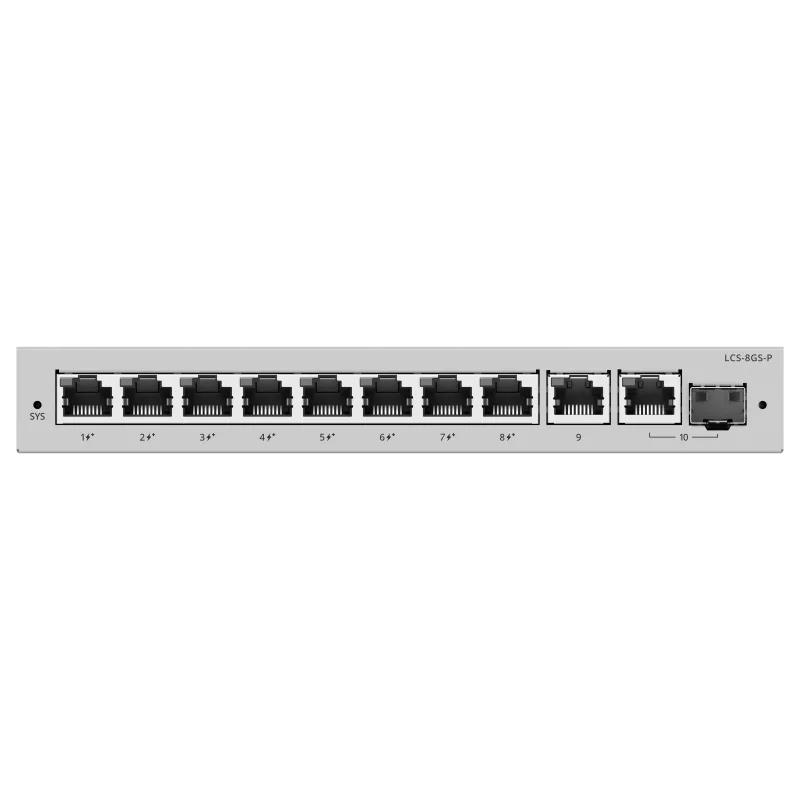
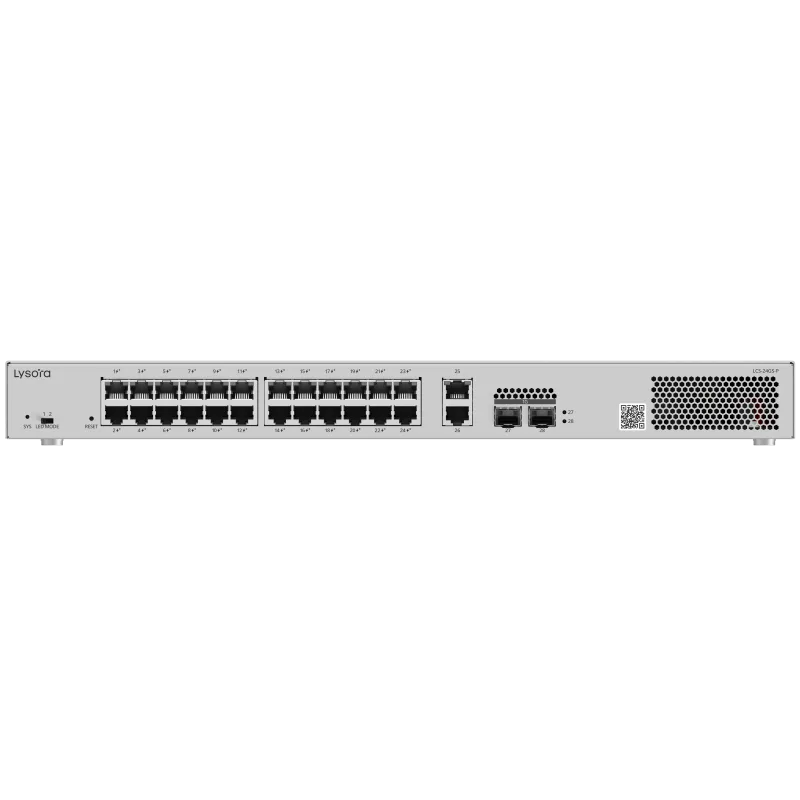
Size the budget by adding the actual draw of every powered device and leaving margin. In the Lysora range the LCS-24GS-P carries a 370 W budget, while compact models such as the LCS-4GS-P and LCS-8GS-P suit smaller edge counts.

Typical device classes

As a planning rule of thumb, most fixed cameras sit in the 802.3af band, while heaters, motors, and higher-power radios push devices into 802.3at or 802.3bt. Confirm each device against its own datasheet before finalising a budget.

  • Fixed dome / bullet IP cameras — usually 802.3af.
  • PTZ cameras, cameras with heaters — usually 802.3at or above.
  • Wi-Fi 6 and Wi-Fi 7 access points — commonly 802.3at.
  • VoIP handsets and simple sensors — usually 802.3af.

PoE outdoors and in industrial cabinets

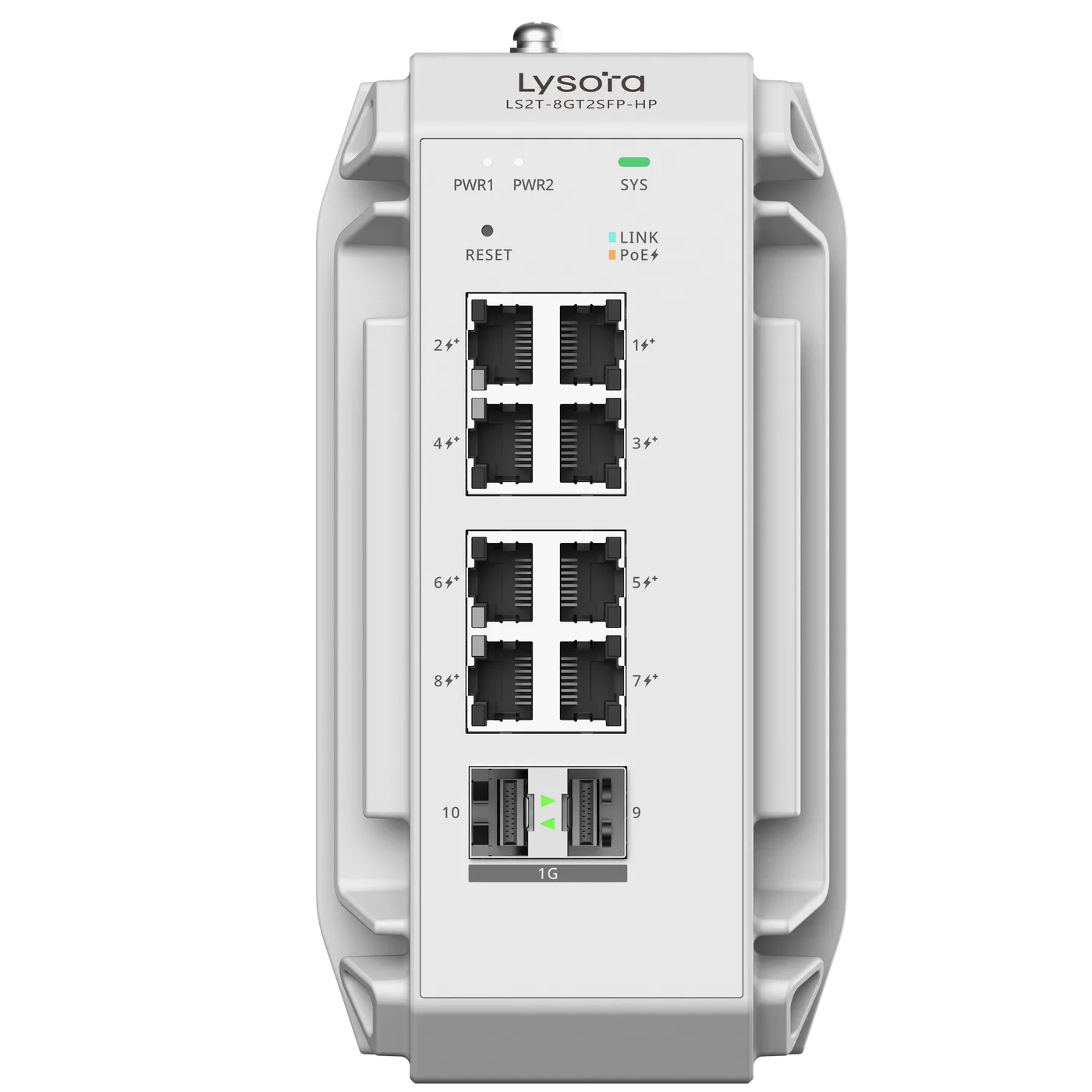
Standards define electrical behaviour, not environment. A rooftop or roadside cabinet needs an industrially rated switch regardless of PoE type — the LS2T-8GT2SFP-HP carries a 240 W budget in a DIN-rail body rated well beyond commercial limits.

Related Products

Equipment referenced in this guide

Models from the official Lysora catalogue that match the requirements described above.

Related Resources

Read next

  • A six-step method for sizing a managed switch — port count, PoE budget, uplinks, switching layer, environment, and management — before the BOQ goes out for pricing.

  • Buying Guides

    Density before coverage: how to decide access point count, mounting type, power, and backhaul for an enterprise wireless deployment that survives a full office.

  • Buying Guides

    When a commercial switch is the wrong choice, and how to specify an industrial one: temperature rating, mounting, DC input, ingress protection, and surge tolerance.

Before You Enquire

Frequently asked questions

What is the difference between PoE and PoE+?

PoE is IEEE 802.3af: 15.4 W at the switch port and 12.95 W guaranteed at the device. PoE+ is IEEE 802.3at: 30 W at the port and 25.5 W at the device. PoE+ ports also power PoE devices, negotiating down automatically.

How do I calculate the PoE budget I need?

Add the rated power draw of every device that will be powered simultaneously, then leave headroom for growth and cable loss. Compare that total against the switch's stated budget — not against the per-port maximum multiplied by port count.

See PoE switches

Can a PoE switch damage a non-PoE device?

No. Standards-compliant PoE performs a detection and classification handshake before applying power, so a non-PoE device connected to a PoE port simply receives data and no power.

Tell us what you need — get a quote today

Four fields, no account, no attachments needed. Our sales team calls back within working hours with pricing and stock status.

Send your requirement, get a quote today

Share a BOQ, a part list, or just a description of the site — our sales team responds within working hours with pricing and stock confirmation.

Prefer to talk? +91 98910 20998