
It is chosen by location, not throughput
An industrial switch is not simply a rugged-looking commercial switch. It is specified for an environment where temperature, vibration, power quality, and dust sit outside what a rack-mounted office switch tolerates. And the decision to use one is driven almost entirely by location, not by throughput.
A sealed roadside cabinet in an Indian summer routinely exceeds the 0–50 °C rating of a commercial switch, because the interior of a closed enclosure runs well above ambient. Equipment installed there fails early and unpredictably. This guide covers the five specifications that actually differentiate industrial hardware, so the right switch reaches the right site.
1. Temperature rating
This is the specification that most often forces the decision. The switch must be rated for the temperature inside the enclosure, not the weather outside it — and inside a sealed cabinet that can be considerably higher than ambient.
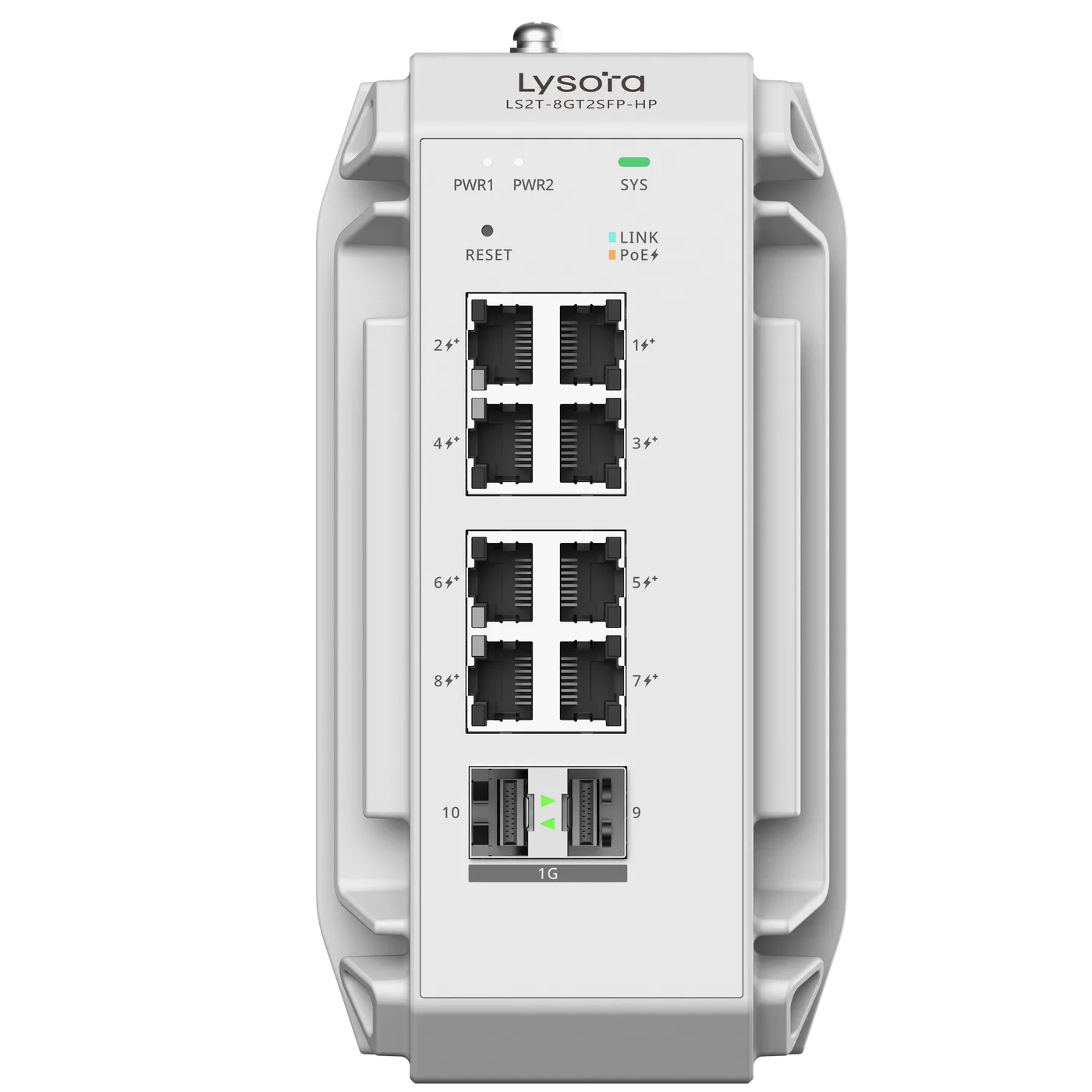
The Lysora LS2T-8GT2SFP-HP is rated -40 °C to +65 °C, extending to +80 °C in ventilated cabinets — an envelope no commercial switch is designed to meet. Matching the rating to the real cabinet temperature is the difference between a switch that lasts and one that fails in its first summer.
2. Mounting and cooling
Industrial switches mount on DIN rail beside PLCs and power supplies rather than in a 19-inch rack, and they are almost always fanless. A fan is a moving part in an environment full of dust — removing it removes the most common mechanical failure.
Fanless does not mean less capable. These switches dissipate heat through the metal chassis instead of forced air, which is a reliability choice for dusty environments, not a performance compromise.
3. Power input
Industrial sites frequently distribute DC rather than AC. A wide DC input range lets one switch work from a panel supply, a UPS-backed DC bus, or a solar-charged battery bank.
Check DC voltage against the PoE budget
Where the switch supplies PoE, confirm the input range against the PoE budget: delivering the full budget often requires the upper part of the voltage range. The LS2T-8GT2SFP-HP accepts 12–56 V DC and needs 46–56 V DC for its full 240 W PoE budget. Sizing the DC supply for the PoE load is a step that is easy to overlook.
4. Ingress protection and surge tolerance
An IP rating describes resistance to dust and water ingress. Inside a sealed cabinet, IP40 on the switch itself is normal, with the enclosure providing the weather seal — the switch and the cabinet are specified together.
Surge protection is separate and equally important. Any copper run that leaves a building can carry induced surge from nearby lightning, so service-port and power-port surge ratings should be checked explicitly, especially for outdoor and perimeter deployments.
5. Management at the edge
Remote sites are the most expensive to visit, so managed industrial switches earn their cost quickly — diagnosing a fault without a site visit is usually the largest saving available. VLAN segmentation also keeps OT traffic separated from camera and IT traffic on shared infrastructure.
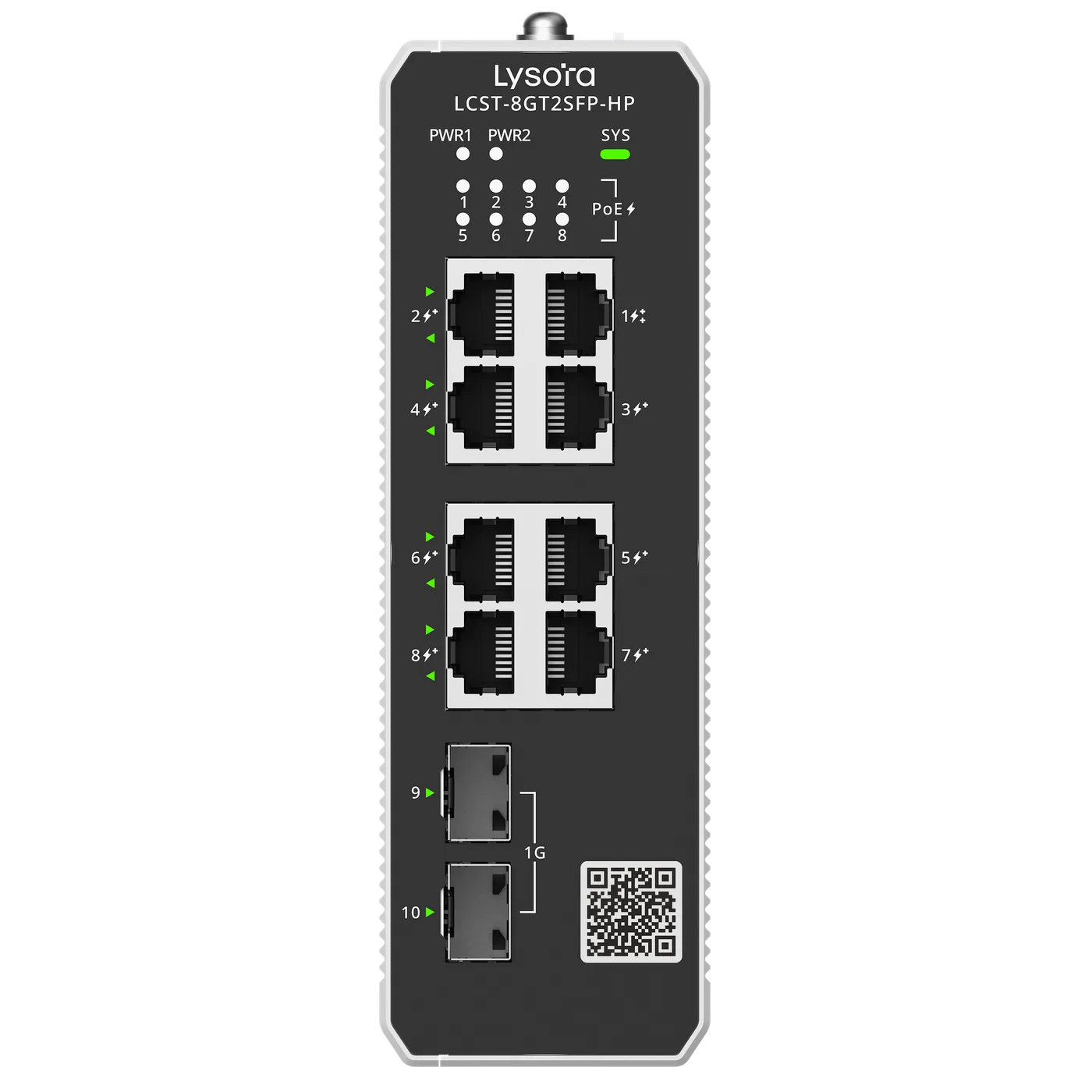
Where cloud management is preferred for a distributed estate, the LCST-8GT2SFP-HP covers a similar industrial envelope with cloud administration, so a fleet of remote sites can be supported from one place.
Redundancy, uptime, and fibre immunity
On a production line or a critical infrastructure site, a single cable fault must not stop the process, so industrial networks are frequently built with redundancy that office networks rarely need. Ring and redundant-path topologies give traffic a second route if one link fails, and redundant power inputs do the same on the electrical side. The specific topology depends on the plant layout and is designed at survey rather than assumed from a datasheet.
Fibre plays a particular role here beyond distance. Between two buildings on different earth potentials, a copper link can carry damaging induced voltage; fibre carries none, because it is glass, not metal. That immunity is why building-to-building industrial links are so often fibre, terminated on SFP ports or media converters at each end. Where an existing copper run must cross that boundary, a media converter to fibre for the span and back to copper is the standard remedy.
Where industrial switches belong
The rule is simple: whenever the switch will sit outside a climate-controlled room — factory panels, roadside and rooftop cabinets, utility sites, unconditioned warehouses — an industrial switch is the correct specification, regardless of its port count. If the location has no cooling and no dust control, a commercial switch is the wrong choice there.
Industrial PoE switches also power cameras and radios at the harsh edge exactly as commercial ones do; the difference is the operating envelope, not the function. Confirm that the DC supply on site can support the full PoE budget you intend to use.
Commercial vs industrial: a side-by-side
It helps to see the two classes contrasted directly, because the differences are consistent and they all trace back to environment. A commercial switch is built for a clean, cooled, powered room; an industrial switch is built for a panel, a cabinet, or a pole. Neither is 'better' — each is correct in its place, and using one where the other belongs is the mistake.
- Temperature: commercial roughly 0 to 50 °C; industrial far wider, e.g. -40 to +65 °C on the LS2T-8GT2SFP-HP.
- Mounting: commercial 19-inch rack; industrial DIN rail beside PLCs.
- Cooling: commercial often fan-assisted; industrial fanless for dust immunity.
- Power: commercial AC mains; industrial wide-range DC from panels or batteries.
- Redundancy: commercial single path is common; industrial often ring or dual-path for uptime.
The one-question test
If you are unsure which you need, ask a single question: will this switch live in a climate-controlled, dust-free, mains-powered room? If yes, a commercial switch is fine. If no — a factory floor, a roadside cabinet, a rooftop, an unconditioned warehouse — specify industrial. The port count, PoE budget, and management needs are then chosen exactly as they would be for a commercial switch; only the operating envelope changes.
Conclusion
An industrial switch is specified by five things: a temperature rating matched to the enclosure, DIN-rail fanless mounting, a wide DC input sized for the PoE load, appropriate ingress and surge protection, and management for remote support. And it is chosen by location — the moment a switch sits outside a climate-controlled room, industrial is the right answer.
Certifications are quoted only as published on each product datasheet, so confirm any project-critical certification there before ordering. Tell us the site conditions — temperature, power, indoor or outdoor — and our team will specify the right industrial switch.